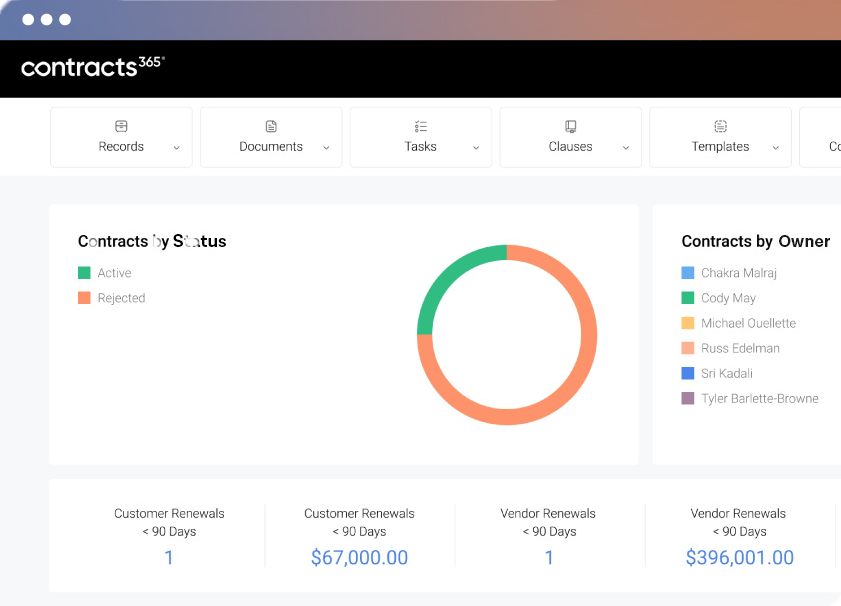
In our recent webinar with Contracts 365 CEO Russ Edelman and VP of Marketing Dave Sandstedt, we discussed how to turn contract reporting data into meaningful action. Here are some key reporting takeaways, including the concept of "Contract Vital Signs" and how they vary by stakeholder. Here is a link to watch or download the full presentation.
Organizations have never had more contract data available to them.
Modern contract management software captures approvals, obligations, renewals, workflow activity, financial commitments, clause deviations, negotiation history, and increasingly, AI-generated insights. The volume of available information continues to grow, yet many leadership teams still struggle to answer relatively straightforward questions.
Which contracts represent the greatest business risk? Where are agreements consistently slowing down? Which supplier relationships deserve attention before renewal? Are contractual obligations being fulfilled as expected?
These are not difficult questions, yet they often require significant manual effort to answer. All too often, reports are exported to spreadsheets, dashboards are customized for individual stakeholders, and contract data is reconciled across multiple systems before anyone feels confident making a decision.
The challenge is rarely a lack of information. More often, organizations have not identified the relatively small number of measurements that provide an accurate picture of contract health.
A useful comparison comes from healthcare.
When someone arrives in an emergency department, physicians have access to hundreds of diagnostic tests. They do not begin by reviewing every available measurement. They begin with a handful of vital signs that quickly indicate whether intervention is needed. Those measurements provide an immediate understanding of the patient's condition while helping determine what should happen next.
Contract management benefits from the same discipline.
Today,, many organizations try to measure everything simply because modern technology allows them to. Far fewer identify the handful of indicators that consistently predict operational performance, legal risk, or financial exposure. The organizations that make this distinction tend to develop reporting that is easier to trust, easier to maintain, and significantly more useful for decision-making.
The objective of contract reporting is not to produce more dashboards. It is to help people make better business decisions.
More Data Doesn’t Automatically Produce Better Decisions
Implementing a contract management system is an important milestone, but centralizing contracts is only the beginning of the journey.
Early success is usually measured by operational improvements. Contracts become easier to find. Approval workflows become standardized. Documents are stored in a governed repository instead of being scattered across shared drives and email.
Those improvements matter, but they also change the expectations placed on the system. Once contract information has been centralized, business leaders naturally begin asking broader questions.
-
How efficiently are agreements moving through the organization?
-
Which suppliers represent the greatest concentration of financial exposure?
-
Where are approval bottlenecks occurring?
-
Which obligations require immediate attention?
Those questions can't be answered by technology alone. They require a reporting strategy built around business decisions rather than available data.
This distinction explains why some organizations are satisfied with their reporting while others continue exporting data into spreadsheets months or even years after implementing a contract management solution.
The software successfully captures information. The organization has never agreed on which information matters most.
Contract Reporting Remains One of the Most Underdeveloped Areas of Contract Management
Reporting rarely receives the same attention as artificial intelligence, workflow automation, or digital contracting. Yet reporting is one of the primary ways leadership evaluates whether a contract management initiative is delivering measurable business value.
Industry research reflects this gap. World Commerce & Contracting reports that only about one-quarter of organizations have established a formal, consistent contract reporting process. Separate research indicates that approximately 80 percent of organizations lack clear accountability for contract performance.
Those statistics suggest that collecting contract information and using contract information are very different challenges.
Many organizations successfully implement a contract management system that captures thousands of contracts and millions of data points. Relatively few establish a framework that turns that information into meaningful operational insight.
Part of the challenge is that reporting serves multiple audiences.
-
Legal leadership evaluates contractual risk differently than procurement.
-
Finance looks for visibility into commitments, renewals, and financial exposure.
-
Executive leadership wants concise indicators that support planning without becoming involved in day-to-day contract administration.
-
Business users are often focused on a much narrower question: What requires my attention today.
Each perspective is valid. None of them requires the same report.
Why Reporting Breaks Down
Across hundreds of contract management projects, the same patterns appear repeatedly. They are rarely caused by reporting technology itself. More often, they reflect governance decisions made long before anyone builds a dashboard.
1. Contract Data Can’t Be Trusted
Every report depends on the quality of the information behind it.
Organizations frequently discover inconsistent metadata, incomplete fields, outdated amendments, duplicate counterparties, or contracts that were never fully updated after execution.
These problems rarely originate from poor technology. They usually develop gradually as agreements evolve while the associated contract data does not.
Maintaining trustworthy data requires ongoing governance throughout the entire contract lifecycle. Required fields need to remain consistent. Amendments should update existing records. Business rules should be enforced automatically whenever possible.
Without those practices, confidence in reporting declines, and people naturally begin verifying information manually or returning to spreadsheets.
No reporting strategy can compensate for contract data that is no longer trusted.
2. Organizations Measure Information Instead of Decisions
Many reporting discussions begin with technology.
-
Which fields should appear?
-
What charts should be available?
-
How many dashboards should be created?
Those conversations are useful, but they often begin in the wrong place. A more productive discussion starts with the decision someone is trying to make.
A Chief Financial Officer preparing quarterly forecasts is unlikely to care how many contracts entered legal review during the previous month. They are much more interested in upcoming renewals, contractual commitments, and agreements representing significant financial exposure.
The same principle applies throughout the organization. Useful reporting starts with business decisions and works backward to identify the information required to support them.
3. Contract Information Lives in Too Many Places
Even organizations with mature contract management software often maintain contract information across multiple repositories: SharePoint, ERP systems. CRM platforms. Email. Legacy contract repositories. Departmental databases.
Each application may serve an important purpose, but reporting becomes increasingly difficult when the same supplier, contract, or business relationship exists in multiple places.
The strongest reporting strategies begin by establishing clear systems of record and maintaining consistent relationships between contract data and the surrounding business applications.
4. Adoption Determines Reporting Quality
Reporting is often viewed as an analytics challenge. In practice, it is equally a user adoption challenge. When maintaining contract information becomes difficult, people postpone updates. When retrieving useful information takes too long, confidence begins to decline. Over time, reports become less representative of actual business activity.
Organizations achieve better reporting when maintaining contract data becomes part of everyday work rather than an administrative exercise.
5. Reports Should Initiate Action
Perhaps the most overlooked reporting principle is that reports should begin a process rather than conclude one. A contract approaching renewal should trigger planning. An overdue obligation should trigger follow-up. A workflow bottleneck should trigger escalation. A contractual risk should trigger review.
The most valuable reporting does more than summarize activity. It connects insight directly to action, allowing the organization to respond while there is still an opportunity to influence the outcome.
Introducing Contract Vital Signs
One of the more useful ways to think about reporting is through the idea of contract vital signs.
Physicians rely on a relatively small number of measurements because those indicators consistently predict overall health. Hundreds of additional measurements may exist, but only a handful guide immediate decisions.
Contract management follows a remarkably similar pattern. Every organization collects extensive contract information. Very few measurements deserve continuous executive attention. The challenge is identifying the indicators that consistently reflect the health of the contracting process.
That conversation usually begins with five practical questions:
- Who needs the information?
- What business question are they trying to answer?
- When do they need it?
- How should they receive it?
- What action should follow?
These questions change the conversation. Instead of asking how many reports should exist, organizations begin asking which measurements genuinely influence business decisions. That shift often produces fewer reports, but reports that are substantially more valuable.
Different Stakeholders Need Different Vital Signs
One of the most common reporting mistakes is assuming every stakeholder needs the same dashboard. In reality, each role views contracts through a different operational lens.
- Legal leadership monitors contractual risk, compliance trends, and obligations.
- Finance focuses on financial commitments, renewals, and forecasting.
- Procurement evaluates supplier performance and commercial exposure.
- Contract managers look for workflow bottlenecks, approval performance, and
- operational efficiency.
- Business users are primarily interested in the contracts and obligations they own.
- Executive leadership needs a concise view of portfolio health that supports planning without requiring operational detail.
These differences are not a reporting problem. They are a reflection of how organizations make decisions.
The strongest reporting strategies recognize those differences and deliver information that aligns with each stakeholder's responsibilities, providing the right contract vital signs to the right audience at the right time.
From Contract Vital Signs to Business Decisions
Identifying the right contract vital signs is only the beginning. The greater challenge is deciding how those measurements should influence the business. This is where many reporting initiatives lose momentum.
Organizations invest considerable effort building dashboards, refining visualizations, and distributing reports, yet relatively little time discussing what should happen after someone reviews them. A report that never changes a decision has limited value, regardless of how sophisticated it appears.
The strongest reporting strategies begin by identifying the business decisions they are intended to support. Once those decisions are understood, the reports become significantly easier to design because every metric has a purpose.
For example, an executive reviewing supplier agreements may not need visibility into every active contract. They may only need to understand which suppliers represent significant financial exposure or which agreements require attention during the next ninety days. A contract manager, by contrast, is more likely to benefit from understanding where approvals are slowing down or which contractual obligations require immediate attention.
The same contract repository can support both conversations, but each audience requires different information because each audience is making different decisions.
What Do Contract Vital Signs Look Like?
Every organization will define its own contract vital signs based on its industry, risk profile, and business priorities. A healthcare provider will monitor different indicators than a manufacturer, and a global procurement organization will care about different metrics than a software company.
Even so, several categories of reporting consistently prove valuable because they help organizations make better decisions instead of simply describing past activity.
1. Contract Renewals
Nearly every contract management initiative begins with renewal reporting, but the most effective organizations look beyond expiration dates.
The real business questions are:
- Which agreements require action during the next 30, 60, or 90 days?
- Which contracts renew automatically if no one intervenes?
- Which customers or suppliers should be engaged before formal renewal discussions begin?
Viewed this way, renewal reporting becomes less about administration and more about protecting revenue, strengthening supplier relationships, and reducing unnecessary business risk.
2. Contractual Obligations
Execution is only one milestone in the life of a contract.
Many of the commitments that create business value—or business risk—occur months or years after an agreement is signed. Insurance certificates expire. Pricing reviews become due. Service levels must be monitored. Deliverables need to be completed. Regulatory commitments require ongoing attention.
Organizations that continuously monitor contractual obligations are often able to identify issues before they become disputes, compliance failures, or missed commercial opportunities.
3. Workflow Performance
Contract cycle time is one of the most common metrics reported by legal and procurement teams. By itself, however, it rarely explains where improvement is needed. A more useful measurement examines each stage of the approval process.
- Where do contracts consistently wait?
- Which approval steps create the greatest delays?
- Are bottlenecks occurring within legal review, procurement, finance, or the business?
Answering these questions allows organizations to improve contracting based on evidence instead of assumptions. In many cases, the perceived bottleneck turns out to be somewhere entirely different than expected.
4. Portfolio Health
Senior leaders typically need a different perspective than operational users. Rather than reviewing individual contracts, executives often want to understand the overall health of the contract portfolio.
Questions commonly include:
- How many contracts are active?
- How many are currently under negotiation?
- What percentage are approaching renewal?
- Where is the organization's greatest financial exposure?
- How is contract volume changing over time?
These indicators provide leadership with a concise view of organizational performance while allowing operational teams to investigate the underlying details when necessary.
5. Contract Risk
Risk reporting has evolved significantly over the past several years. Historically, organizations focused on obvious issues such as expired agreements or missing signatures.
Today, legal teams increasingly monitor non-standard clauses, contractual obligations, insurance requirements, compliance commitments, AI-assisted clause analysis, and other indicators that help prioritize legal review.
The objective is not to identify every contractual difference. It's to focus legal attention where it provides the greatest value and where the organization's risk profile warrants closer review.
Reports Inform. Dashboards Engage.
The webinar highlighted an important distinction that is often overlooked. Reports and dashboards solve different problems.
Reports work well when information needs to be distributed consistently. Executives often prefer scheduled reports delivered in Excel or PDF because they fit naturally into existing management routines. The information arrives automatically without requiring another application or another login.
Dashboards serve a different purpose. They create an interactive working environment where users can personalize what they see, investigate trends, drill into contract details, and begin working directly from the information in front of them.
Most mature contract management systems benefit from both. Reports support governance and executive oversight. Dashboards support day-to-day operational execution. Understanding when each approach is appropriate helps organizations deliver information in a way that matches how people actually work.
The Best Reporting Leads to Action
Perhaps the most useful observation from the webinar is that reporting should never exist in isolation. When organizations identify an upcoming renewal, the next step should not depend on someone remembering to send an email.
When an obligation becomes overdue, someone should not need to notice it on a spreadsheet before action begins. Modern contract management should connect reporting directly to governed business processes. A renewal report can initiate a review workflow. An overdue obligation can create a risk record. A contractual milestone can notify the appropriate stakeholders. A workflow bottleneck can trigger escalation before deadlines are missed.
In each case, reporting becomes the beginning of a business process instead of the end of an analytical exercise.
Trusted Reporting Begins with Trusted Data
Every discussion about reporting eventually returns to the same foundational requirement. The data has to be trusted.
Artificial intelligence can identify clause deviations. Dashboards can visualize trends. Workflow automation can coordinate business processes. None of those capabilities compensate for incomplete metadata, inconsistent contract records, or disconnected systems.
Organizations that produce the most valuable reporting invest first in governance. They establish clear ownership of contract data. They define consistent business rules.They maintain information throughout the life of the agreement instead of treating contract execution as the finish line.
That foundation enables something far more valuable than accurate reports. It enables confident decisions.
Why This Matters for Microsoft 365 Organizations
Organizations that have standardized on Microsoft 365 already possess many of the foundational capabilities required for effective contract reporting. SharePoint provides a governed repository. Microsoft Entra ID establishes security and identity. Power BI delivers enterprise analytics. Teams supports collaboration across legal, procurement, finance, and business stakeholders.
The role of a contract management platform is to extend that foundation with structured contract data, workflow automation, obligation management, reporting, dashboards, and AI that operates within governed business processes.
For Microsoft-centric organizations, this approach also avoids creating another disconnected repository for contracts. Reporting remains connected to the broader Microsoft ecosystem while contract data supports governance, analytics, automation, and business decision-making across the enterprise.
Better Reporting Starts with Better Questions
Organizations rarely struggle because they lack reports. More often, they struggle because they have never agreed on which measurements genuinely indicate the health of their contracting process. That is why the idea of contract vital signs is so valuable. It encourages organizations to move beyond collecting data and toward identifying the handful of indicators that consistently influence business decisions.
When reporting is built on trusted data, aligned with each stakeholder's responsibilities, and connected to governed business processes, contracts become more than documents stored for compliance purposes.
They become business assets that help organizations manage risk, improve operational performance, strengthen commercial relationships, and make better decisions.
Request a Demo
If your organization is still relying on spreadsheets, manually assembled reports, or disconnected systems to understand contract performance, it may be time to rethink your reporting strategy.
See how Contracts 365 helps organizations build trusted contract reporting, role-based dashboards, workflow automation, and AI-powered contract lifecycle management while keeping contracts and data securely within Microsoft 365.
Request a personalized demonstration to see how Contracts 365 can help your organization identify the contract vital signs that matter most. Download or listen to the full webinar here.