Healthcare organizations manage a remarkably diverse range of contracts. Depending on the organization, these may include agreements with physicians, nurses and other healthcare professionals, suppliers, technology vendors, facilities, research partners, payors, consultants, and service providers.
The contracts themselves can also be complex. An agreement may contain detailed payment terms, rates, service requirements, renewal provisions, regulatory obligations, data protection requirements, and other commitments that need attention long after the contract has been signed.
As contract volume increases, managing these agreements through email, spreadsheets, shared drives, and disconnected systems becomes difficult to sustain. Business and legal teams need to know where contracts stand during negotiation, who is responsible for approvals, what was agreed to, which obligations remain outstanding, and when action needs to be taken.
This is where healthcare contract management software can provide significant value. A modern contract lifecycle management (CLM) system creates a structured process for managing contracts from initial request and negotiation through execution, obligation management, renewal, and eventual expiration.
For healthcare organizations evaluating contract management software, the following capabilities deserve particular consideration.
Why Healthcare Contract Management Requires a Different Level of Control
Contracts are business assets. They define relationships, establish financial commitments, allocate risk, and document what each party has agreed to do. In healthcare, those agreements often operate within an environment where regulatory requirements, privacy and security concerns, financial terms, and operational dependencies intersect.
That makes the information contained within contracts particularly important.
A physician agreement, for example, may include compensation terms, credentialing requirements, renewal provisions, and other obligations. A technology agreement may require scrutiny of data protection and security provisions. Supplier and service agreements can include pricing, service levels, insurance requirements, termination rights, and renewal dates.
The challenge grows as contracts move across departments. Legal may negotiate the language, procurement may manage the vendor relationship, IT may evaluate technology and security requirements, finance may need access to pricing information, and operational teams may ultimately be responsible for fulfilling the contract.
An effective healthcare contract management system should provide a common framework for managing these activities while giving different stakeholders appropriate access to the information they need.
1. A Secure, Centralized Contract Repository
A reliable contract repository is the foundation of effective contract management.
When contracts are stored across email accounts, shared drives, departmental systems, and individual computers, organizations can struggle to establish which agreement is current, where supporting documents are located, who owns the relationship, and what terms were ultimately negotiated.
Centralizing contracts addresses part of the problem. The larger opportunity is to connect the contract document with the data and activity surrounding it.
Contract metadata can capture information such as contract type, owner, counterparty, effective date, expiration date, renewal terms, financial information, and other attributes. Search, permissions, version history, and audit information can then make that information easier to find and manage.
Security also deserves particular attention in healthcare. Organizations should understand where their contracts and contract data will reside, how access is controlled, and whether introducing a CLM system requires sensitive information to be stored in another vendor's cloud.
For organizations built around Microsoft 365, a contract management system that uses the organization's existing Microsoft environment as its contract repository can offer an important architectural advantage. Contracts can remain within the organization's Microsoft cloud while the CLM system adds the workflows, data structure, automation, and lifecycle management capabilities required to manage them effectively.
2. Automated Contract Requests, Workflows, and Approvals
Healthcare contracting often involves multiple stakeholders and different approval requirements depending on the agreement.
A low-value services contract may follow a relatively straightforward process. A physician agreement, technology contract, or agreement involving sensitive data may require additional legal, financial, operational, compliance, or IT review.
Trying to coordinate these processes manually creates unnecessary administrative work and makes it harder to determine where a contract stands.
Contract management software can introduce structure at the beginning of the process. Standardized request forms help collect the information needed to initiate an agreement, while workflow rules can route the contract to the appropriate reviewers and approvers based on contract type, value, department, risk, or other criteria.
This provides a more consistent process and creates a record of the reviews and approvals that occurred along the way.
The ability to configure workflows is especially useful in healthcare because contracting processes are rarely uniform across the organization. The system should be flexible enough to accommodate different agreement types and approval requirements without forcing every contract through the same process.
3. More Consistent Contract Creation and Negotiation
As contract volume increases, standardization becomes increasingly valuable.
Approved contract templates and clause libraries can help legal teams establish preferred language while allowing business users to initiate routine agreements more efficiently. When alternative language is required, clause playbooks can provide approved fallback positions and guidance for handling common negotiation issues.
This creates greater consistency while preserving the ability to escalate unusual or higher-risk provisions for additional review.
Contract management software should also support the practical mechanics of negotiation, including redlining, version control, collaboration, and maintaining an accurate record of how an agreement changed during review.
AI is beginning to play a larger role here as well. AI-assisted contract review such as AI Extraction and AI Negotiation, can help identify clauses, summarize agreements, compare language with organizational standards, surface potential issues, and support negotiation.
See a video of how AI Negotation works
See a video of how AI Extraction works
The value of these capabilities depends heavily on how they fit into the organization's broader contracting process. For healthcare organizations, AI should operate within established permissions, workflows, review standards, and governance requirements so that automation supports the people responsible for making legal and business decisions.
4. Contract Obligation Management
Some of the greatest contract risks emerge after an agreement has been signed.
Healthcare contracts may contain reporting requirements, payment commitments, notice periods, service-level requirements, insurance provisions, credentialing requirements, renewal dates, and other obligations that must be managed over months or years.
Storing the executed contract is therefore only one part of contract management. Organizations also need a reliable way to identify what the agreement requires and make sure those responsibilities reach the people who need to act on them.
Contract management software can help teams capture obligations, assign responsibility, establish due dates, track progress, and escalate missed or approaching deadlines. Automated reminders can provide advance notice of renewals and other important events, giving teams time to review the agreement and make an informed decision.
More sophisticated processes may involve related obligations in which the completion or outcome of one activity affects another. The ability to manage these dependencies can become particularly valuable as the size and complexity of the contract portfolio grows.
5. Support for Healthcare: Specific Contract Data
Healthcare organizations should also consider whether a contract management system can accommodate the information that matters to their particular contracting processes.
Generic contract fields such as counterparty, effective date, expiration date, and contract value are useful across industries. Healthcare organizations may need to capture additional information related to physicians, providers, services, rates, credentialing, facilities, regulatory requirements, or other healthcare-specific considerations.
For example, some healthcare contracts incorporate Current Procedural Terminology (CPT) codes and associated rate information. Capturing that information as structured contract data can make it more accessible to the people and systems that rely on it.
The broader principle is flexibility. Healthcare organizations should be able to structure contract data around their own business requirements without forcing complex agreements into a rigid data model.
6. Compliance, Governance, and Risk Visibility
Healthcare organizations operate within extensive regulatory and governance requirements. Contracts are one source of information needed to understand and manage those responsibilities.
CLM software can provide greater visibility by capturing important contract provisions and obligations as structured data. Organizations can then identify agreements with particular terms, monitor required activities, review approval histories, and maintain a more complete record of contract activity.
This can be particularly valuable when teams need to understand risk across an entire portfolio rather than reviewing individual agreements one at a time.
The system should also provide appropriate permissions and auditability. Organizations need to understand who can access sensitive contract information, who has made changes, which approvals occurred, and how the contract progressed through its lifecycle.
Contract management software does not replace legal judgment, regulatory expertise, or an organization's compliance program. It provides a governed environment in which contract information can be managed more consistently and made available to the people responsible for acting on it.
7. Better Contract Data and Reporting
Many organizations have contracts but lack reliable contract data.
Critical information remains buried in documents, making seemingly straightforward questions surprisingly difficult to answer. How many agreements renew in the next 90 days? Which contracts contain particular liability provisions? What financial commitments are coming due? Which obligations are outstanding? Where are contracts getting delayed during approval?
Modern contract management software should make it possible to capture and report on this information across the contract portfolio.
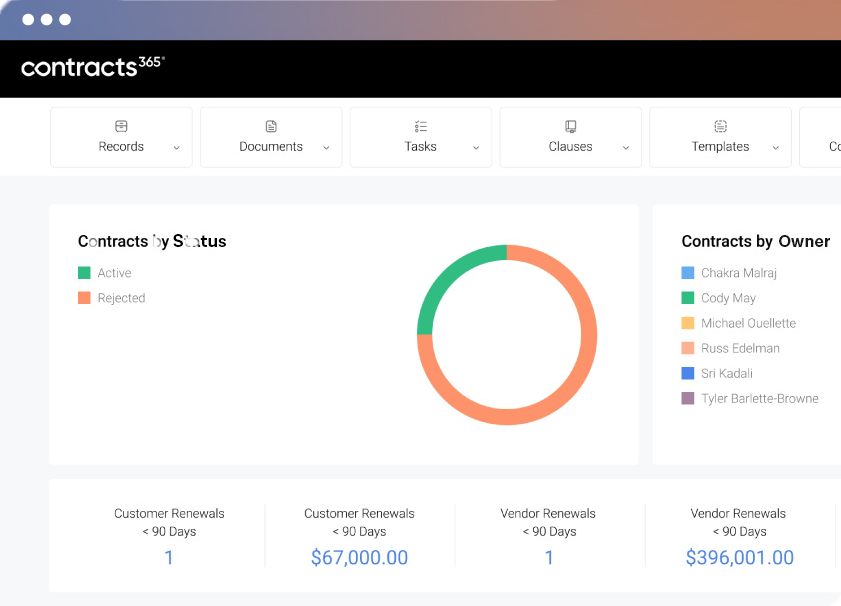
Dashboards and reports can provide visibility into renewal exposure, contract status, cycle times, obligations, financial terms, risk provisions, and other information relevant to legal and business teams. Over time, this data can also help organizations identify process bottlenecks and understand where contracting practices can be improved.
AI can extend these capabilities by extracting information from existing contracts and making previously inaccessible contract data available for search, analysis, and reporting.
This is an area where governance matters. AI-generated contract data becomes considerably more useful when it is incorporated into a defined business process, reviewed where appropriate, and maintained as part of a trusted contract record.
8. Integration with the Broader Business Environment
Contracts rarely exist in isolation.
Information used during contracting may originate in CRM, ERP, procurement, finance, or other business systems. Information created during the contract lifecycle may also need to be available to those systems after the agreement is signed.
Healthcare organizations should therefore consider how a prospective CLM platform fits within their existing technology environment.
For organizations that rely heavily on Microsoft 365, this includes understanding how the system works with applications employees already use, such as Word, Outlook, Teams, SharePoint,Dynamics 365, and the Power Platform.
A Microsoft-based approach can also reduce the need to introduce an entirely separate environment for contract storage, identity, security, and collaboration. Contracts 365, for example, uses the customer's existing Microsoft 365 environment as the contract repository and extends that environment with CLM-specific workflows, data, automation, reporting, and lifecycle management capabilities.
This architecture can be particularly relevant for IT teams evaluating CLM alongside legal and procurement. The decision involves more than application functionality. Data ownership, security architecture, integrations, identity management, governance, and the organization's existing technology investments all deserve consideration.
9. Usability and Adoption Across the Organization
Contract management software systems are often selected by legal or procurement teams but used by a much broader group of people.
Physicians, administrators, operations teams, finance, IT, procurement, and other business users may need to request contracts, provide information, participate in approvals, check status, or manage obligations.
The user experience therefore matters.
Highly capable CLM software can still create friction if employees have difficulty understanding how to use it or must continually move between unfamiliar systems to complete routine work.
Organizations should consider how easily business users can perform the contract-related tasks relevant to their roles. They should also evaluate how well the system fits into existing ways of working.
For Microsoft 365 organizations, giving users access to contract processes through familiar Microsoft applications can reduce some of the change associated with implementing a new enterprise system. It also makes CLM less of a standalone legal application and more closely connected to the environment where people already collaborate and conduct business.
10. AI That Supports Governed Contract Processes
AI has expanded what contract management systems can do, but healthcare organizations should evaluate these capabilities in the context of real contracting processes.
Useful applications can include extracting contract data, summarizing agreements, identifying important provisions, assisting with review and negotiation, and helping teams locate information across a large contract portfolio.
The practical value comes from connecting these capabilities to the contract lifecycle.
Extracted information should become usable contract data. Identified obligations should be available for assignment and tracking. Negotiation assistance should work within approved language and review processes. Access to AI capabilities should reflect the same security and permissions that govern the underlying contracts.
This approach allows healthcare organizations to gain efficiency from AI while maintaining the oversight required for consequential legal and business decisions.

Questions to Ask When Evaluating Healthcare Contract Management Software
The right CLM system will depend on the organization's contracting processes, technology environment, risk profile, and business priorities. During an evaluation, healthcare organizations should consider questions such as:
- Where will our contracts and contract data be stored?
- How does the system manage security, permissions, and access?
- Can workflows be configured for different contract types and approval requirements?
- Can the system accommodate healthcare-specific data such as CPT codes, rates, and credentialing information?
- How are obligations, notice periods, and renewals identified and managed?
- What capabilities are available for contract creation, review, and negotiation?
- How does AI operate within established contract workflows and governance?
- Can we report across our portfolio on risk, financial terms, renewals, obligations, and contract performance?
- How does the platform integrate with Microsoft 365 and our other business systems?
- How much change will the system require from the people who need to use it?
These questions move the evaluation beyond a checklist of software features. They help determine whether a platform can support the way the organization actually creates, negotiates, manages, and uses its contracts.
Choosing Healthcare Contract Management Software
Healthcare contracts contain information and commitments that affect operations, finances, risk, compliance, and important business relationships. Managing them effectively requires more than a place to store documents.
A modern contract management system should provide a reliable foundation for contract data, structured workflows, negotiation, obligation management, reporting, and governance throughout the contract lifecycle. It should also fit within the organization's broader technology environment and be practical for the people expected to use it.
For healthcare organizations already invested in Microsoft 365, Contracts 365 extends that environment with contract lifecycle management capabilities while allowing contracts and contract data to remain within the organization's Microsoft cloud. The platform supports healthcare-specific requirements including configurable workflows, obligation management, CPT codes and rate information, secure contract storage, AI-assisted contract processes, and integration with familiar Microsoft applications.
The result is a contract management environment designed to help legal, procurement, IT, and business teams manage contracts as the business assets they are.
Learn more about Contracts 365 Healthcare Contract Management Software or request a demo to see how Contracts 365 supports healthcare contracting within Microsoft 365.