
As organizations evaluate the best contract management software and contract lifecycle managment (CLM) systems or 2026, the question is no longer whether to invest in a solution — it’s which features truly drive measurable business impact.
Modern contract management systems must do more than store documents. It must enable AI-powered insights, automate workflows, integrate with enterprise systems, and provide real-time visibility across the entire contract lifecycle.
The market is crowded with vendors promising innovation. But what capabilities actually matter?
This guide outlines the 10 essential contract management software tools for 2026, based on evolving enterprise requirements, AI advancements, Microsoft 365 integration trends, and operational governance needs.
If your organization relies on contracts to drive revenue, manage risk, and ensure compliance, these are the features that define best-in-class contract management software today.
At a Glance: 10 Essential CLM Software Features & Tools
- AI-powered contract analysis and metadata extraction
- Self-service contract requests for business users
- Automated document assembly
- Contract obligation management and compliance tracking
- Enterprise integrations and connected systems
- Workflow automation for contract approvals
- Secure centralized contract repository
- Electronic signature integration
- Contract analytics and reporting dashboards
- Advanced contract search and metadata visibility
What Features to Look for in the Best Contract Management Software for 2026
When evaluating the best contract management software for 2026, organizations should prioritize solutions that go beyond document storage. Modern platforms must deliver AI-powered metadata extraction, workflow automation, enterprise integrations, obligation tracking, and real-time reporting. The right contract management software should improve visibility, reduce risk, and scale with growing contract volume. Below are the ten essential tools and capabilities that define best-in-class solutions in 2026.
1. AI-Powered Contract Management and Metadata Extraction
AI-powered capabilities are now a defining characteristic of leading CLM platforms. Modern AI enabled software uses machine learning to analyze contracts, extract key terms, identify risk, and accelerate review processes at scale. What was once experimental technology is now a practical tool for improving speed, accuracy, and governance across the contract lifecycle.
AI can automatically scan legacy and third-party agreements to identify renewal dates, termination clauses, pricing terms, governing law, and other critical provisions. By transforming unstructured contract language into structured, searchable data, organizations gain immediate visibility into risk and obligations without manual review.
One of the most impactful advancements in 2026 is AI-powered metadata extraction. Users can upload executed contracts and automatically extract, summarize, and classify key information. This significantly reduces manual data entry, improves consistency, and accelerates onboarding of third-party agreements.
AI-driven negotiation tools are also evolving. Within Microsoft 365 environments, AI can compare third-party language against approved clause libraries directly in Microsoft Word, flag deviations, and suggest alternative language. This enables faster negotiations while maintaining control over risk exposure.
When embedded within structured contract management software — rather than operating as a standalone AI tool — these capabilities improve adoption, maintain governance, and ensure results are reviewable and auditable.
As contract volume and complexity increase, AI-powered contract management moves from a competitive advantage to a strategic necessity.
Contracts 365 and Microsoft Applied AI services have partnered to bring AI-powered capabilities to contract management. Learn more about our initiatives to power our contract management software with Microsoft AI in our recent webinar or browse our AI resource page for webinars, e-books and more.
2. Self-Service Contract Management
The best contract management systems empower more than just legal teams — it enables business users to initiate, track, and manage contracts independently through structured self-service portals. Self-service contract management reduces bottlenecks, accelerates turnaround times, and allows legal teams to focus on higher-value work.
Modern contract management systems allow employees to request contracts, trigger automated workflows, and track approval status in real time. Standard agreements can be generated instantly from approved templates, eliminating repetitive drafting and reducing delays. Automated approval workflows ensure the right stakeholders are notified and escalation rules keep projects moving.
Self-service capabilities also extend to contract visibility. With appropriate security permissions, employees can search for existing contracts, review relationship history, and access key metadata without relying on legal to retrieve documents. This improves operational efficiency and reduces internal friction.
For third-party agreements such as vendor contracts, users can upload documents directly into the system. The software can automatically route the agreement to the appropriate reviewer based on subject matter expertise, contract type, or business unit. When integrated with Microsoft 365, these workflows operate within familiar environments like SharePoint and Outlook, improving adoption while maintaining governance.
As contract volume grows, self-service functionality becomes essential. It increases productivity across the organization while preserving structured oversight — a hallmark of modern contract management software.
3. Automated Document Assembly
Automated document assembly is another defining feature of the leading contract management software systems. It allows organizations to automatically generate fully formatted contracts using pre-approved templates, structured data fields, and conditional business rules. Instead of drafting agreements manually, contracts are dynamically created based on information submitted in a request form.
For example, if a business user requests a nondisclosure agreement and indicates that financial information will be disclosed, the system can automatically insert enhanced confidentiality clauses. Conditional logic ensures the correct language is applied every time, reducing risk and eliminating inconsistencies.
When integrated with Microsoft 365, automated contract creation can occur directly within familiar tools such as Microsoft Word and SharePoint. Business users can initiate requests, generate documents, and collaborate without leaving their existing Microsoft environment. This preserves user adoption while introducing structured governance.
Automated contract creation improves speed, enforces approved language, and allows legal teams to scale efficiently. As contract volume increases, this capability becomes essential to maintaining both control and productivity.
4. Contract Obligation Management
Contract obligation management is a critical capability of leading contract management software. After a contract is signed, organizations must track performance commitments, payment terms, service levels, reporting requirements, and regulatory obligations. Without structured tracking, these obligations are often overlooked.
The best CLM software captures obligations as structured data and assigns them to responsible stakeholders. Automated alerts, reminders, and reporting dashboards ensure that key milestones and compliance requirements are not missed. This transforms contracts from static documents into active, governed assets.
For vendor and supplier agreements, obligation tracking helps monitor service level agreements (SLAs), rebate thresholds, and performance metrics. For customer contracts, it ensures commitments made during the sales cycle are fulfilled. For regulated organizations, it provides audit-ready visibility into compliance requirements.
Within Microsoft 365 environments, obligation tracking can be layered directly on top of SharePoint-based document storage. Structured metadata, automated workflows, and reporting capabilities create visibility without forcing users into unfamiliar systems.
As contract volume grows, manual tracking becomes unsustainable. Structured obligation management reduces risk, improves accountability, and strengthens operational governance — making it one of the most important features to evaluate when selecting contract management software in 2026.
Learn more about contract obligations and how organizations track them.
Download E-Book: AI-Powered Contract Management
Learn More
5. Enterprise Integrations and Connected Systems
For many years now, we have found that contract management systems that are integrated with other corporate applications (such as Microsoft 365) deliver much more value to the company than a standalone, siloed application.
For example, Contracts 365 produces a packaged Microsoft Dynamics CRM contract management integration. For those not familiar, a CRM or Customer Relationship Management application is often the primary tool used by sales reps to manage their deals. Our real-time integration allows sales reps to request and receive a contract back from legal in minutes or seconds without ever leaving Microsoft Dynamics. The time it takes for the sales rep to receive the contract and get it into the hands of their customer is drastically reduced and, so is the time it takes to close the deal and recognize the revenue from the sale. Enabling sales reps to access all the contract management-related data, documents, and tools while remaining in Dynamics, improves their productivity and allows more time for selling and therefore more sales. Realizing these gains by connecting sales and legal teams is significant for most companies.
There are plenty more examples to share, here are just a few:
- Integrating with a financial application can speed the process of invoicing and receiving payments.
- Integrating with a supply chain management application can ensure raw materials are ordered when purchase contracts are executed.
- Integrating with a project management application can reduce the time required for new customer onboarding.
- Integrating with vertical software solutions can streamline operations. For example, Contracts 365's Contract Management Software for Real Estate is designed to integrate with leading property management software including Yardi, MRI, Real Page, and others.
In summary, connected systems provide value through increased revenue, savings, productivity, focus, and informed decision-making.
6. Workflow Automation
Workflow automation capabilities exist in many enterprise applications, and their presence in contract management software is extremely valuable. We’ve observed that Contract Management and Legal Teams are consistently understaffed. The heightened need to continually complete more quality work in less time and with the same or less headcount is why workflow automation is so valuable for contract managers.
Workflow automation is a feature that can be applied to a wide range of use cases, but it shines when used for contract approvals, which tend to be tedious and time-consuming (See our Guide to Contract Notice Periods). Automated contract approvals, by comparison, can utilize automated reminders to keep approvers on track and your process on time. Escalations can also be built into the process to address approvers that fall way behind and jeopardize your project goals.
Workflow automation is an important tool to help you focus on your most important work.
7. Secure Centralized Contract Repository
Having a secure and centralized platform is important when managing sensitive data in contracts. A centralized platform allows for easy control and management of private contracts, enabling you to store, search, and track your contracts from one place. And ensuring that this data is secure, is paramount. Contract management software that is cloud-based and aligned with industry-leading security protocols is essential to consider.
8. Electronic Signature Integration
When integrated with electronic signature platforms, contract management software enables organizations to send, receive, and sign contracts electronically, saving users time and hassle. It is important that contract management software be fully integrated with leading digital signature companies such as DocuSign and Adobe Sign. With Adobe Sign and DocuSign, contract signatories, and end users can sign forms anywhere, on any device. This eliminates the need to log in or download software and ensures compliance and security. In addition, business users can easily view key tracking data to know when recipients receive, view, reassign, sign, and forward the e-signature envelope, to ensure key milestones are being met. Contract management software that natively integrates with electronic signature platforms makes it easier to move your organization to a fully digital and highly automated contracting process.
9. Contract Analytics and Reporting
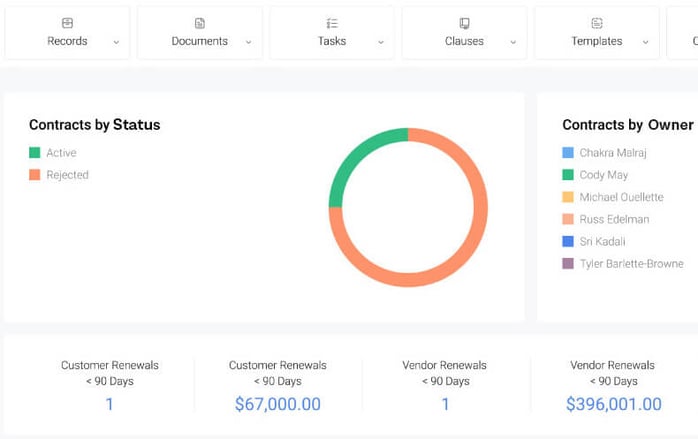
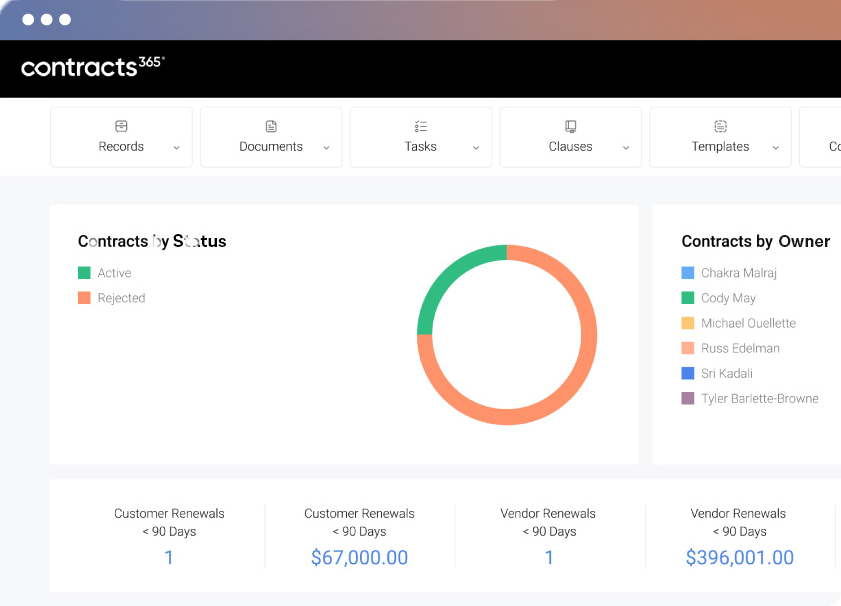
LeadingCLM software should provide insights and analytics on your contracts, including metrics on performance, risk, and compliance. Often these reports can be customized for at-a-glance intelligence or scheduled delivery. In addition, it is ideal to have software that provides customized dashboard views designed to match business roles for legal teams, contract managers, procurement and sales.
10. Advanced Contract Search and Metadata Visibility
As contract volume grows, organizations must be able to quickly locate agreements, clauses, and key terms across thousands of documents. Leading contract management software enables advanced search capabilities powered by structured metadata, allowing users to instantly find contracts by party, date, obligation, contract value, renewal terms, or other critical attributes.
By transforming contract language into structured, searchable data, the best CLM platforms provide real-time visibility into the entire contract portfolio. Business users can quickly access the information they need from any device—desktop, tablet, or mobile—ensuring contracts remain accessible, actionable, and aligned with operational decision-making. Read our ebook: The importance of Metadata in Contract Management.
How to Choose the Best Contract Management Software
When evaluating contract management software, organizations should consider several factors:
- AI capabilities and metadata extraction accuracy
- Integration with enterprise systems such as Microsoft 365 and CRM platforms
- Workflow automation and approval management
- Obligation tracking and compliance monitoring
- Reporting and analytics capabilities
- Ease of adoption for business users
As contract volume and regulatory requirements grow, organizations increasingly prioritize platforms that integrate directly into their existing technology ecosystems.
In summary, if your business counts on contracts to function, these ten contract management features and tools have the capability to add value when implemented as a part of your solution.
If you’d like to learn more about our Contract Management Software for businesses that run Microsoft 365, please don’t hesitate to reach out to us or, even better, request a demo and we can show you how it works in real-time.
How to Compare Contract Management Software Solutions
When evaluating contract management software, organizations should compare vendors based on several critical factors:
- AI capabilities and metadata extraction accuracy
- Integration with enterprise systems such as Microsoft 365, CRM, and ERP platforms
- Workflow automation and approval management
- Obligation tracking and compliance monitoring
- Reporting and analytics capabilities
- Security, governance, and scalability
Organizations operating in Microsoft 365 environments often prioritize solutions that integrate directly with SharePoint, Outlook, and Dynamics 365 to improve adoption and reduce system fragmentation.
If your organization relies on Microsoft 365, choosing the right contract management software is critical. Learn what to look for in our guide to contract management software for Microsoft 365.
Frequently Asked Questions About Contract Management Software
What is contract management software?
Why do companies outgrow basic contract management software?
Basic contract management software may work when contract volumes and processes are relatively simple, but it often becomes limiting as organizations grow. Increasing contract volume, more complex approval workflows, multiple departments, reporting requirements, integrations, and compliance needs typically require a more scalable contract management system with greater automation, visibility, and control.
What features should contract management software include?
What is the difference between contract management and CLM software?
What is the best contract management software (CLM) for Microsoft 365?
Contracts 365 is purpose-built for Microsoft 365 enabling your legal and business teams to manage contracts quickly and securely. Unlike contract management systems that sit on separate cloud platforms, Contracts 365 leverages your Microsoft tenant, security settings, and SharePoint repository, while providing bi-directional sync with Dynamics 365, Salesforce, and the Power Platform to connect intelligence across your organization.