How to choose the best contract management software for your business.
Table of Contents
- Introduction
- What Is Contract Management Software?
- Key Features to Look for in Contract Management Software
- Tip 1: Define Your Industry and Vertical Requirements
- Tip 2: Ensure Technical Compatibility and Integrations
- Tip 3: Identify the Contract Management Problem You Are Trying to Solve
- Tip 4: Consider Your Company Size and Growth Plans
- Tip 5: Evaluate Vendor Industry Expertise and Reputation
- Tip 6: Work With a CLM Consultant
- Tip 7: Attend Contract Management Events
- Tip 8: Request a Demo and Meet the Vendor Team
- Questions to Ask Contract Management Software Vendors
- Why Organizations Choose Contracts 365
- Final Thoughts
1. Introduction
Choosing the best contract management software vendors in 2026 requires more than comparing feature lists. Today’s contract lifecycle management (CLM) systems are deeply connected to AI, automation,Microsoft 365 ecosystems, CRM systems, and enterprise data governance strategies.
With so many vendors in the market, organizations must take a structured approach to evaluation—balancing functionality, integrations, usability, scalability, and industry expertise.
This guide provides eight practical tips to help you confidently select the best contract management software for your organization.
2. What Is Contract Management Software?
Contract management software is a platform that helps organizations manage the entire contract lifecycle—from creation and negotiation to execution, tracking, renewal, and compliance.
Modern contract management systems typically include:
- AI-powered contract analysis and metadata extraction
- Centralized contract repository
- Automated workflows and approvals
- Obligation and renewal tracking
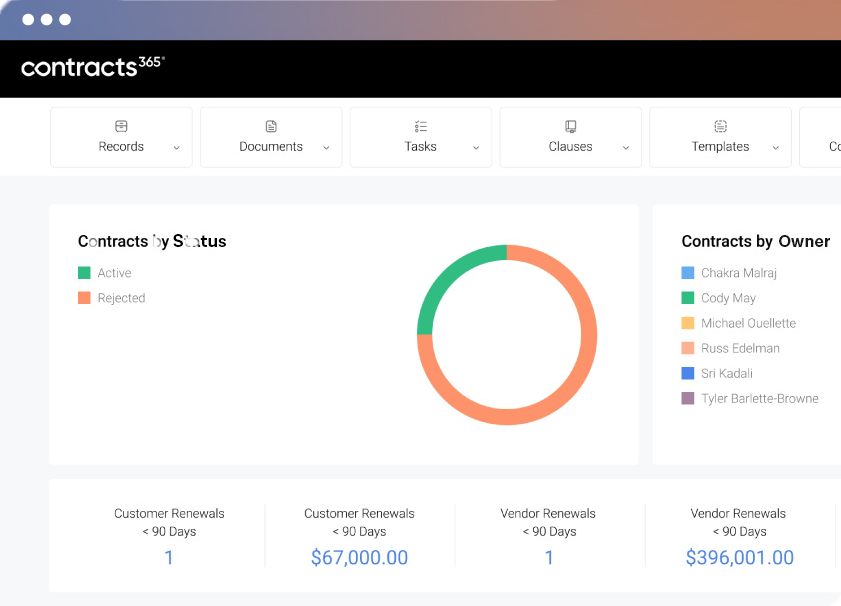
- Reporting and analytics dashboards
- E-signature integrations
The goal is to reduce manual work, improve visibility, and minimize contract risk.
3. Key Features to Look for in Contract Management Software
Before evaluating vendors, it’s important to understand the core capabilities that define the best contract management software:
- AI-driven contract extraction and clause analysis
- Centralized, searchable contract repository
- Automated approval workflows
- Obligation and milestone tracking
- Renewal and expiration alerts
- E-signature integration
- Advanced reporting and dashboards
- CRM and ERP integrations
- Microsoft 365 integration (SharePoint, Outlook, Teams, Dynamics 365)
- Enterprise-grade security and permissions
The strongest solutions combine usability with deep automation and integration capabilities.
4. Tip 1: Define Your Industry and Vertical Requirements
Different industries have different contracting requirements, regulatory frameworks, and risk profiles.
For example:
- Healthcare organizations require strict compliance and auditability
- Real estate firms need lease and asset management capabilities
- Manufacturing and energy companies require complex procurement workflows
Choosing a vendor with proven experience in your industry ensures the system aligns with your operational and compliance needs.
5. Tip 2: Ensure Technical Compatibility and Integrations
Your contract management software must integrate with your existing business systems.
Most organizations rely on:
- Microsoft 365
- CRM platforms like Dynamics 365 or Salesforce
- ERP systems
- E-signature tools
- Document management systems
Strong integrations eliminate manual data entry, reduce errors, and ensure contract data flows seamlessly across systems.
6. Tip 3: Identify the Contract Management Problem You Are Trying to Solve
Before evaluating vendors, clearly define your business challenges.
Common problems include:
- Lack of visibility into contracts
- Missed renewals or obligations
- Slow approval cycles
- Manual document handling
- Compliance risks
- Disconnected systems
Once these pain points are defined, you can align them with the right contract management capabilities such as automation, AI, reporting, and workflow optimization.
7. Tip 4: Consider Your Company Size and Growth Plans
Contract management software should match both your current and future scale.
Consider:
- Number of contracts managed annually
- Number of users across departments
- Geographic or multi-entity complexity
- Growth trajectory of the organization
- Future automation and AI needs
The best contract management software scales with your business over time.
8. Tip 5: Evaluate Vendor Industry Expertise and Reputation
Vendor credibility is a critical factor in selection.
Evaluate:
- Customer case studies and testimonials
- Industry analyst reports (e.g., Gartner, Forrester)
- Product innovation and roadmap
- Thought leadership content and webinars
- Peer reviews and customer feedback
A vendor’s market reputation often reflects long-term product maturity and support quality.
9. Tip 6: Work With a CLM Software Consultant
Contract lifecycle management consultants can help guide vendor selection and implementation.
They typically assist with:
- Vendor evaluation and comparison
- Implementation planning
- Data migration strategy
- Workflow design and optimization
- Training and adoption support
This is especially valuable for complex enterprise environments or lean internal teams.
10. Tip 7: Attend Contract Management Events
Industry events provide direct access to vendors and real-world product demonstrations.
Examples include:
- World Commerce & Contracting (WorldCC) events
- CLOC conferences
- VirtualCLM webinars and summits
These events allow you to compare vendors side by side and ask detailed implementation and product questions.
11. Tip 8: Request a Demo and Meet the Vendor Team
Once you have narrowed your shortlist, request a live demo.
A demo helps you evaluate:
- User experience and usability
- Workflow configuration
- AI and automation capabilities
- Reporting and analytics
- Vendor implementation approach
Meeting the vendor team also helps assess cultural fit and long-term partnership potential.
12. Questions to Ask Contract Management Software Vendors
When evaluating the best contract management software vendors, ask:
- How does your platform support our industry requirements?
- What integrations do you offer with Microsoft 365 and CRM systems?
- How does your AI improve contract visibility and efficiency?
- What is your implementation timeline?
- How do you ensure data security and compliance?
- How does your platform scale with enterprise growth?
- What training and customer support do you provide?
13. Why Organizations Choose Contracts 365
Contracts 365 is a leading contract management software platform built for organizations using Microsoft 365.
It enables organizations to manage the full contract lifecycle with:
- Native Microsoft 365 integration
- AI-powered contract extraction and metadata generation
- Centralized contract repository within SharePoint
- Automated workflows and approvals
- Seamless integration with Outlook, Teams, and Dynamics 365
- Enterprise-grade security and compliance controls
Contracts 365 is designed to improve usability, governance, and efficiency across the entire contract lifecycle.
14. Final Thoughts
Selecting the best contract management software vendors in 2026 requires a structured and strategic approach.
By focusing on industry fit, integrations, scalability, usability, and vendor expertise, organizations can confidently select a contract management software solution that reduces risk, improves efficiency, and supports long-term growth.
Contract management is no longer just a legal function—it is a critical business capability that drives operational performance and strategic decision-making.
Ready to See Contract Management Software in Action?
If you’re evaluating the best contract management software vendors in 2026, the fastest way to understand what truly fits your organization is to see the platform in action. Request a demo of Contracts 365 today to see how contract management software built for Microsoft can transform your contracting process.